The modern agentic product tool stack
This note comes from self-directed R&D. It's my go-to stack for building with AI, and I'm running most of it on Dacard's own work now. Agents do the work. People make decisions.
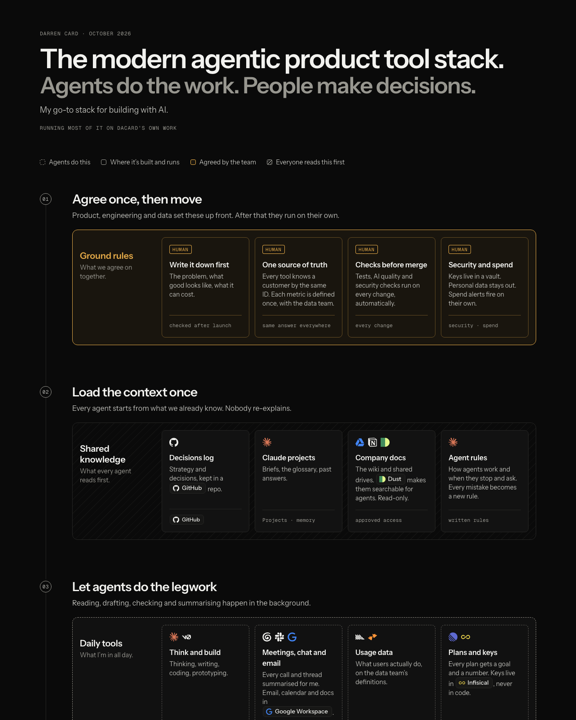
Product, engineering and data agree the ground rules once: write it down first, one source of truth, checks on every change, spend alerts. After that they run on their own. Every agent loads the same shared knowledge, so nobody re-explains anything.
- Write it down first
- One source of truth
- Checks before merge
- Security and spend
- The loop
- Decide
- Build
- Ship
- Measure
- Listen
- Call it
Dashed: agents do thisBrass: agreed by the teamLogos are trademarks of their owners
Agents do the legwork in the background, reading, drafting, checking and summarising every call. On my own builds I run the systems the product is built on. On a team, engineering owns them, and I can see what shipped and how it's doing without asking for a report.
Work moves in a tight loop. People set the goal and make the call: keep it, change it or stop it. Agents carry the build, the release, the measuring and the listening in between.
PostHog comes first wherever it covers the job, which keeps the tool count down. The 18 tool categories of a few years ago now fit in fewer, broader tools, and some layers are new.
It travels. Client work uses the same setup in their accounts. At a company, IT signs off first and changes go through the team that owns each system.
If you're putting one of these together, agree the rules first, then pick tools that keep them without anyone having to watch.
This is the first of six notes on the stack. The next five cover what replaced 18 old tools, how I build with context first, how a change ships, how data and work flow, and every tool on one page.